Surface cracking in roughly 4–6 weeks at low RH (below ~40%).
LANDERCOLL · Structured home care
Solid Toilet Cleaner Formulation Additives — Structure, Moisture Control & Stability Solutions
Unlike liquids where viscosity leads the brief, a solid or semi-solid must hold its form through manufacturing, packaging, shipping, and months of storage — before it ever reaches the user.
Crumble early, dry in-pack, or let actives migrate through the matrix, and the product fails before it cleans. LANDU's HPMC and CMC from the LANDERCOLL portfolio target structural binding, moisture management, and distribution — not repurposed construction grades.

“Solid toilet cleaner formulations fail for predictable reasons: premature drying, structural crumbling, uneven active ingredient distribution, and instability during storage. LANDU's HPMC and CMC address each of these failure modes within a single additive system — which is why cellulose ethers from LANDERCOLL are used in home care cleaning systems across more than 60 countries.”
— LANDU Technical Team, LANDERCOLL Application Series
Why Do Solid Toilet Cleaner Formulas Fail Without the Right Additive?
Failure modes are well documented — and they share one root cause: inadequate moisture management, structural binding, and ingredient distribution support.
- Structural crumbling in transit
- Surface drying & hard crust
- Active migration in the matrix
- Inconsistent dissolution in water
USD 9.2B
Global toilet care market, 2024 — Grand View Research, 2025
USD 12.8B
Projected by 2030 — solid & in-cistern formats driving longer-lasting, lower-maintenance demand
That growth pressures manufacturers to deliver reliable shelf life, consistent performance, and structural integrity through global supply chains.
LANDERCOLL home care content is explicit: HPMC can help retain moisture to reduce premature drying or crumbling; cellulose ethers help keep particles evenly distributed for consistent results and longer shelf life — the defining requirements of a well-formulated solid toilet cleaner.
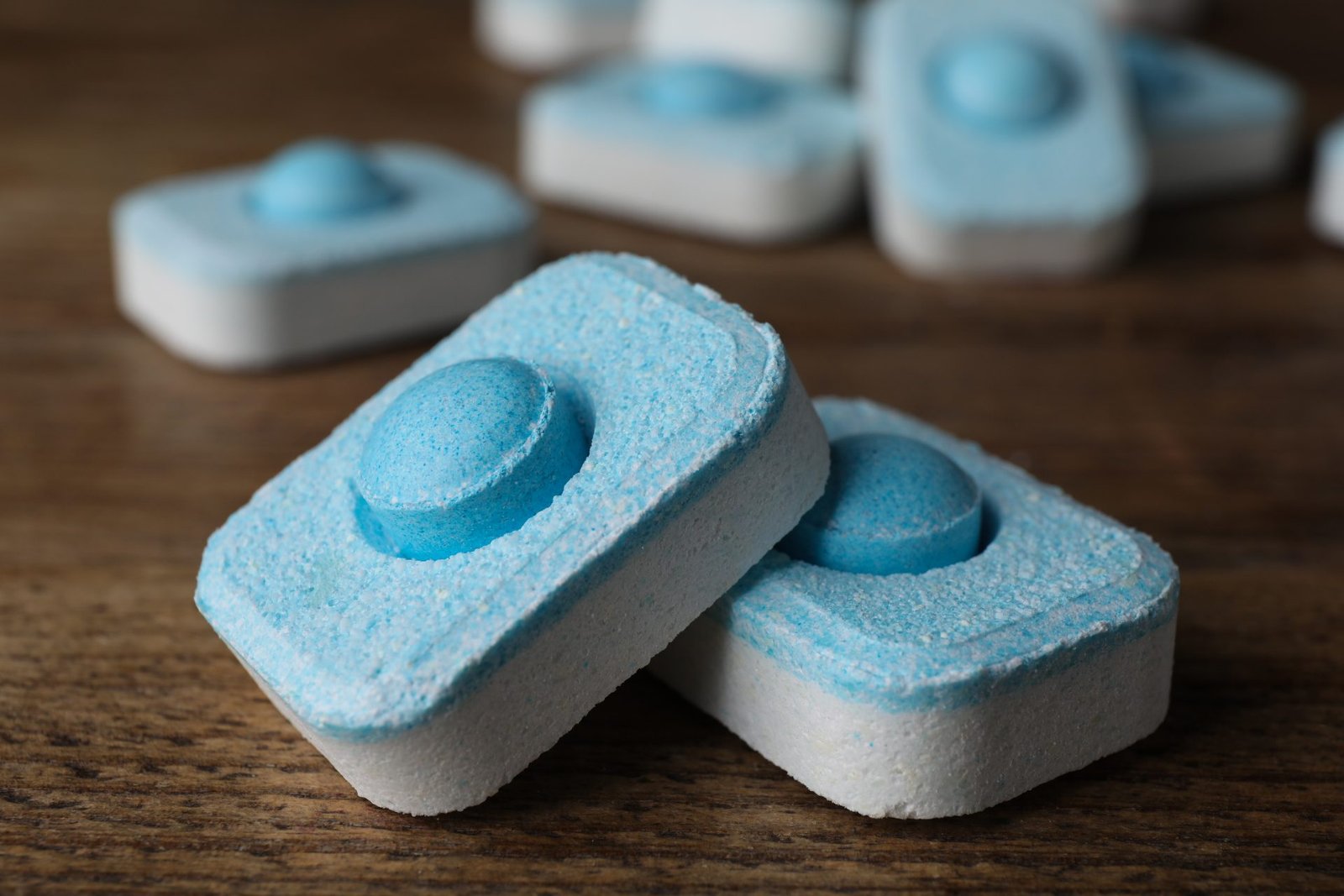
How Do You Maintain Structural Integrity?
Blocks, tablets, granules, or sticks must survive compression or extrusion, handling, transport, and storage across temperature and humidity.
HPMC acts as a structural binder by forming a polymer network in the matrix. Typical use levels: roughly 0.5–3% by weight depending on format, hardness target, and dissolution goals — binding strength without unnecessarily compromising active performance.
Compression tablets, extruded sticks, and in-cistern granules each favor different viscosity grades. LANDU supports grade selection to your forming process, with samples for validation before commercial orders.
How Do You Prevent Premature Drying & Crumbling?
HPMC's hygroscopic character and moisture-retaining film in the matrix slow moisture loss, preserving flexibility and cohesion — critical for long supply chains and dry climates.
Structural integrity through 12+ weeks under the same low-RH stress.

How Do You Keep Actives Evenly Distributed?
Bleaches, acids, fragrance, and colorants can segregate under temperature cycling when densities and particle sizes differ.
LANDERCOLL detergent content: cellulose ether helps keep particles distributed evenly — supporting consistent performance and shelf life. HPMC acts as a distribution aid during forming, helping lock particles in a more uniform arrangement before the matrix sets.
How Do You Control Dissolution & Release?
Too fast: cleaning and fragrance don't last. Too slow: insufficient active per flush. The goal is a controlled, repeatable profile.
HPMC's film-forming and matrix-binding properties contribute to dissolution control. Grade (viscosity, substitution) and use level tune flush lifetime — system-specific; best refined with LANDU technical support and your actives, forming process, and water conditions.
Complementary chemistry
What Role Does CMC Play?
Where HPMC leads on binding and moisture, CMC adds soil anti-redeposition — reducing reattachment of loosened scale and organics to the bowl after actives lift them. Valuable for in-cistern blocks and under-rim formats in continuous contact with flush water.
CMC is core to LANDU's daily chemical portfolio and can improve perceived long-term cleanliness between active cleaning events.
Explore CMCWhich LANDU Products Are Most Relevant?
HPMC as primary; CMC as natural complement; HEMC/MHEC and HEC for specific process or climate scenarios.
| Product | Primary role in solid toilet cleaner | Key technical advantage |
|---|---|---|
| HPMC | Structural binding, moisture retention, distribution, dissolution control | Film-forming; moisture-retaining; tunable dissolution |
| CMC | Soil anti-redeposition, stabilization | Reduces redeposition on bowl surfaces |
| HEMC / MHEC | Structural support, thermal stability | Warm / humid storage or distribution |
| HEC | Binder support in aqueous processing | Compatibility with some anionic surfactant solid formats |
Before & After: HPMC & CMC in the System
Structural integrity
Without cellulose binder, friability in drop tests can exceed 2%. With 1–2% LANDERCOLL HPMC, friability drops sharply; cohesion holds through transport and storage simulation.
Moisture retention
Without support, 8–12% moisture loss in ~8 weeks at 35°C / 40% RH can drive cracking. HPMC slows loss to protect integrity over intended shelf life.
Ingredient distribution
Cross-section analysis: HPMC systems show more uniform active distribution vs. binder-free matrices where density drives segregation.
Cleaning performance
CMC 0.5–1.5% contributes measurable anti-redeposition in flush-cycle testing — cleaner bowls between events.
3 sites · 75,000 t/yr
500+ partners · 60+ countries
ISO 9001 · EU REACH

Who Is This Page For?
Manufacturers of solid toilet cleaners, in-cistern blocks, under-rim cleaners, and other structured household products evaluating binders, moisture control, and distribution — HPMC and CMC merit a direct technical conversation.
Grade depends on format, forming process, active package, and storage. LANDU provides recommendations, free samples with technical process reports, and formulation guidance before volume commitments.
Ready to Improve Your Solid Toilet Cleaner Formula?
Structural stability, moisture retention, even distribution, controlled dissolution — LANDU pairs grades with technical expertise.
500+ manufacturers across 60+ countries trust LANDERCOLL cellulose ethers for home care.
Frequently Asked Questions About Solid Toilet Cleaner Additives
Which additives are most relevant?
HPMC and CMC are the most directly applicable: HPMC for binding, moisture, distribution, dissolution tuning; CMC for anti-redeposition between flush cycles. Together they cover structural and functional performance.
How does HPMC prevent crumbling?
Hygroscopic behavior and film-forming slow moisture egress from the matrix, preserving cohesion — as documented in LANDERCOLL public home care content for detergents and cleansers.
What does CMC contribute?
Primary contribution: anti-redeposition of loosened soil and scale on bowl surfaces — especially relevant for in-cistern and under-rim continuous-flush exposure.
How does HPMC help ingredient distribution?
During forming, HPMC helps suspend and distribute actives before set; LANDERCOLL household detergent content supports even particle distribution for consistency and shelf life.
Can HPMC control dissolution rate?
Yes — film-forming and matrix binding influence release. Grade and level tune lifetime (e.g. flush count or weeks); optimization is system-specific with LANDU technical support.
Typical HPMC use level?
Roughly 0.5–3% by weight depending on format, process, hardness, and dissolution targets — tablets vs. extruded sticks vs. granulated blocks differ.
How do I select the right grade?
Depends on format, forming process, actives, dissolution, moisture sensitivity, and storage. Recommendations, samples, and technical reports — start with a technical inquiry; no commitment.