Viscosity mismatch
Too thin or too heavy for the application — the pour and dosing experience breaks before the consumer reads a single claim.
LANDERCOLL · Home Care
Liquid dishwashing detergent is one of the most performance-demanding products in the home care category. Formulators don't just need it to clean — they need it to look right on the shelf, pour correctly at the sink, stay stable for 18+ months in storage, and hold up in formulas loaded with surfactants, salts, and electrolytes.
That's a lot to ask from a single system. LANDU's cellulose ether additives — specifically detergent-grade HPMC and the broader LANDERCOLL daily chemical portfolio — are engineered to help dishwashing detergent formulations hit every one of those targets simultaneously.

“A well-formulated dishwashing detergent needs to balance at least five competing variables at once: flow behavior, visual clarity, salt tolerance, storage stability, and processing efficiency. LANDU's detergent-grade cellulose ethers address all five within a single additive system — which is why they're used by manufacturers across more than 60 countries.”
Most formulation failures come down to one of three root causes — and standard thickeners rarely solve all three at once.
Too thin or too heavy for the application — the pour and dosing experience breaks before the consumer reads a single claim.
Unstable appearance signals poor quality at retail — even when cleaning performance is sound.
Surfactant–salt interactions can collapse systems that were never designed for ionic load.
Here's the thing — most standard thickeners aren't designed for the specific chemistry of a dishwashing detergent system. Surfactant-heavy, salt-loaded, pH-variable formulas need an additive that can work with the system rather than fighting it.

Market context
According to the Global Household Cleaning Products Market Report (Grand View Research, 2024), the liquid dishwashing segment accounts for over 38% of total household cleaning product sales worldwide, with premium and transparent gel formats growing faster than conventional opaque products.
That growth is driven by consumer demand for products that look as effective as they perform — putting visual clarity and stable texture directly on the formulation brief.
LANDU's detergent-grade HPMC is specifically surface-treated for fluid and semi-fluid home care systems — engineered from the ground up for this application, not repurposed construction-grade material.
Strong formulations require five things to work together. Miss one, and you'll hear about it — either from QC, or from customers.
Viscosity in a dishwashing detergent isn't just about thickness — it's about flow profile. The target is a shear-thinning profile: the product holds its body at rest, then flows freely when squeezed or poured.
LANDERCOLL's cellulose ether products deliver this behavior. In practice, a dishwashing detergent can feel substantial and premium in the bottle while dispensing cleanly without dripping or clogging.

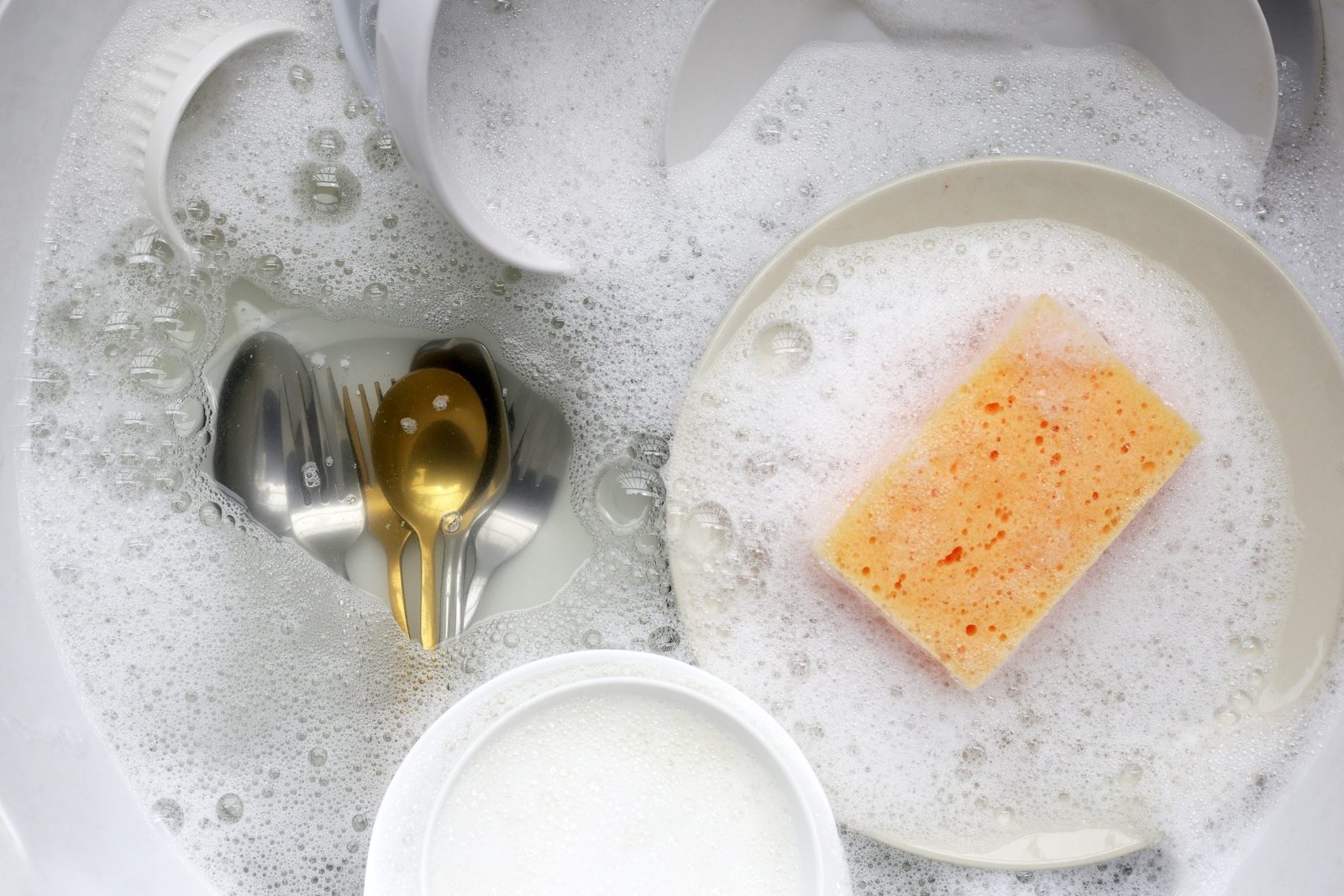
Clarity matters commercially. A hazy or cloudy liquid signals instability — even if performance is perfect. For transparent or lightly tinted gel formats, haze is a dealbreaker at retail.
LANDU's detergent-grade HPMC is documented to support higher clarity and improved transparency through better dispersion and reduced haziness — a function of particle size distribution, substitution degree, and surface treatment.
Salt tolerance is non-negotiable in most modern dishwashing formulas. Sodium chloride adjusts viscosity; sulfates and builders add ionic load. That environment can destabilize conventional thickeners.
LANDU's detergent-grade HPMC is documented for salt and electrolyte tolerance — maintaining viscosity contribution and compatibility in high-ionic-strength systems. As a non-ionic polymer, it avoids the precipitation pitfalls common with some anionic thickeners when electrolyte concentrations rise.
For salt-thickened anionic surfactant systems, HPMC can act as a reliable secondary rheology modifier without undermining the primary thickening mechanism.
Any formula with insoluble particles — pearlescent agents, opacifiers, abrasives, botanical extracts — needs anti-settling support. Without it, particles migrate to the bottom; consumers read that as spoilage or poor quality.
LANDERCOLL application content highlights anti-settling support in home care systems: HPMC increases continuous-phase viscosity enough to slow sedimentation dramatically, extending shelf life for suspension-type gels.

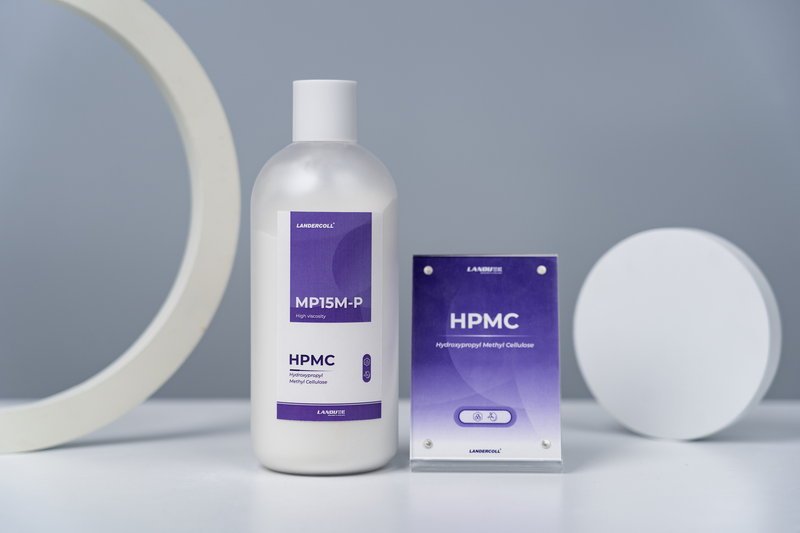
Cold-water dispersibility is a manufacturing concern that doesn't always get enough attention at the formulation stage. Hot dissolution, heated vessels, or long hydration cycles add cost to every run.
LANDU's surface-treated detergent-grade HPMC disperses without clumping in ambient water, hydrates quickly, and reaches its viscosity contribution without elevated temperatures — translating to shorter batch times, lower energy use, and fewer variables on high-volume lines.
For most liquid dishwashing applications, detergent-grade HPMC is the primary recommendation. HEMC, HEC, and CMC address specific scenarios.
| Product | Primary function in dishwashing detergent | Key advantage |
|---|---|---|
| HPMC Detergent grade | Viscosity building, clarity, salt tolerance, anti-settling | Surface-treated for cold-water dispersion; non-ionic; transparent systems |
| HEMC / MHEC | Rheology modification, thermal stability | Useful when higher-temperature processing or storage is a factor |
| HEC | Thickening in aqueous surfactant systems | Good compatibility with anionic and nonionic surfactant blends |
| CMC | Soil anti-redeposition, system stabilization | Supports cleaning performance by reducing soil reattachment |
Without cellulose thickener, a typical anionic dishwashing base may read 50–200 mPa·s at low shear — thin for premium positioning. With 0.2–0.3% LANDERCOLL detergent-grade HPMC, the same formula can reach 800–2,000 mPa·s while keeping a shear-thinning, pour-friendly profile.
Incompatible thickeners can push haze above 50 NTU. Detergent-grade HPMC is designed to help keep haze low for transparent or lightly tinted premium gels.
Salt-thickened systems using HPMC as a co-thickener can show improved viscosity stability across temperature cycling (4°C to 45°C) versus salt-only response.
Cold-water dispersibility can cut hydration time from 30–45 minutes (typical standard grades) to under 15 minutes in many production scenarios.
If you're a dishwashing detergent manufacturer, product development formulator, purchasing manager, or private-label contractor evaluating cellulose ether additives, LANDU's detergent-grade portfolio is worth a direct technical conversation.
The right grade depends on surfactant type, target viscosity, pH, salt content, clarity targets, and manufacturing process — not something a single web page can fully resolve. What this page can do is point you to the right starting point.
LANDU supports grade selection, sample testing, and formulation guidance. Free samples are available with detailed technical process reports so you can validate performance in your own system before committing to a commercial order.

If you need better viscosity control, improved clarity, stronger electrolyte stability, or more efficient manufacturing dispersion, LANDU has the product grade and technical support to get you there.
500+ manufacturers across 60+ countries already trust LANDERCOLL cellulose ethers for daily chemical applications.
FAQ
Detergent-grade HPMC from LANDU is the most directly applicable product for liquid dishwashing systems — viscosity, transparency, salt and electrolyte tolerance, anti-settling support, and cold-water dispersibility within a single non-ionic cellulose ether compatible with common surfactant chemistries.
HPMC builds viscosity through polymer chain entanglement in the aqueous phase. At 0.1–0.5% by weight, detergent-grade HPMC contributes a shear-thinning profile: body at rest, flow under force — desirable for premium feel without sacrificing pour or dispensing.
NaCl and other electrolytes are common — as modifiers or byproducts. Many thickeners lose performance or precipitate at high ionic strength. Detergent-grade HPMC maintains contribution and compatibility because of its non-ionic character.
Yes. Detergent-grade HPMC is documented for higher clarity and reduced haze, driven by particle size distribution and surface treatment that support dispersion and minimize light scattering.
It means the grade hydrates in ambient water without heat or excessively long mixing. Surface-treated detergent-grade HPMC reduces batch time and avoids heated vessels — improving energy use and batch-to-batch consistency at scale.
Selection depends on viscosity targets, surfactant package, pH, salt content, clarity requirements, and process. LANDU provides recommendations, samples, and technical process reports — start with a technical inquiry.
Yes — three facilities, 75,000 tons combined capacity, 500+ partners across 60+ countries. LANDERCOLL cellulose ethers are ISO 9001 certified and EU REACH compliant for major regions including Europe, North America, Southeast Asia, and the Middle East.